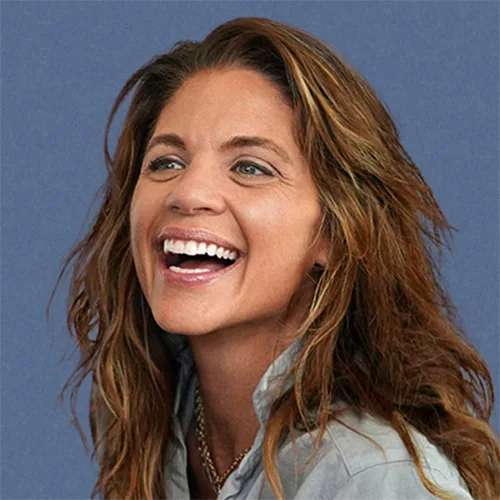
Kate Bowler: Hello my friends and welcome back to a brand new season of Everything Happens. I am so excited to introduce you to new friends this fall. There’s going to be new episodes that drop every Tuesday so just make sure that you’re subscribed on like whatever podcast app you listen to so you do not miss an episode. And this season we’re going to sharing video of every conversation on the Spotify app or on YouTube. So if you prefer to watch and just see if I manage to do my hair that day Please join us and I’ll also link it in the show notes. Okay, so now to today’s episode. There’s a story that we were told about motherhood and it goes something like this. It will be the best thing you ever do. You will fall in love instantly. The hard parts are all gonna be worth it. You won’t even remember them. You will glow. And then. Of course, you actually become a parent, and the story that you were handed and the life you are actually living turns out to be completely different. Of course you still love your kids in a way that splits you open. And also, some afternoons you lock yourself in the bathroom and cry into a hand towel because someone needed a granola bar opened, but not like that. And then they somehow only have one sock on and then the little people need dinner again today for some reason. And then you have an inbox that you can’t even find your way out of. Everything about this is gonna feel hard and impossible and life will feel beautiful and life feel hard but no one will tell you that both are somehow simultaneously true about parenting. My guest today built her whole life around telling the truth about actual motherhood. I’m speaking with Libby Ward. She’s a creator and a speaker and an advocate for women and mothers, and she’s better known to more than a million and a half people online as Diary of an Honest Mom. She’s also the author of Honest Motherhood, and most importantly, of course, she is a fellow Canadian. Libby has built an incredible community by being so funny and so honest and so willing to talk about motherhood as a remuneration. My friend, thank you so much for coming to North Carolina. My glorious home and studio, it feels really good to have you here. Welcome to Everything Happens.
Libby Ward: It is my pleasure. Thank you so much for having me.
Kate Bowler: I feel like my worlds are colliding. The version where we both know where.
Libby Ward: Towns in Ontario are. Right. Like I feel like I don’t make a good Canadian cause I don’t do winter sports at all or care about them that much. But I do love Canada.
Kate Bowler: I know we really do we’re such softies and yet also like the secret the secret badassery is like but have you ever been outside in minus 40? I have. Livia you wrote this really really beautiful book and one of the nicest parts about reading it you know as like just as like a someone who wants to hear a beautiful story but like also as your friend. Is it felt really beautiful to know how many layers, how many like chapters of you that you have been through. And I wondered if we could start at the very beginning. What was the earliest version of you that was trying to make sense of like, what your role was in the family?
Libby Ward: I don’t remember a lot from before I was, you know, eight, nine years old. But my earliest memories are around making mom happy. So I was raised by a mom who had undiagnosed and untreated mental health disorders in the 90s, when like people didn’t talk about therapy or getting help and we were in and out of poverty. We moved 18 times before I was 18 years old. And so there was a lot of sort of the chaos in our home and a lot just dysregulation and what’s gonna happen next and ups and downs and that sort of thing. And so I became really good at being a helper and at being good. And it felt good to be good and good to responsible and good to help bring in money, whether it was ripping the cushions off the couch to find money in the corners or pawning off. Different things in the house or, you know, having yard sales on a Tuesday morning and, you know like send my brother out front with like our coffee table and plates and dishes and be like, let’s sell them. And I was like, you and your brother were like partners. Yeah. Big conspiracy. Yeah. Oh, for sure. And I definitely there was this like flip flop between emotional instability in our home and like, what are we going to get each day? And this like deep sense of pride that I could fix it. Like I became really good at fixing it. I became, became really at pretending in the outside world that everything was okay at home and just adjusting to a new home, a new school, a new set of friends, a, a new boyfriend coming in and out of our lives. And I became a master at sort of like switching who I needed to be and how I needed to be in how I need to show up in order to make everybody else feel comfortable. And that really sort of became my roadmap for how to be a person is making other people feel comfortable and making sure things are handled. And that sort of was true no matter where we lived. And when I was 11, my mom met someone and we ended up moving away and moved six times in two years and then eventually settled on a farm, on a hobby farm.
Kate Bowler: A hobby farm.
Libby Ward: Where I and my brother did a lot of the work of taking care of the cows and the chickens and the gardens and cooking and cleaning and…
Kate Bowler: People sometimes develop very romantic stories about farms, but like, I think you and I know a lot of farm people and like the look in their eye when they say, I will never paint another fence again. There’s a, there’s a too much work. There’s too much responsibility. There is a, this is not, I am not a child anymore.
Libby Ward: Correct. And it wasn’t like I had a lot of friends who had farms but it was like the family farm and mom and dad worked hard and the kids worked hard and they all worked hard together and they enjoyed the fruits of their labor together but my reality was different and that my mom and my stepdad went to the city to work each day my brother and I would wake up early we would you know make the bottles of formula and feed the baby cows and get ourselves ready for school, and then we’d come home from school, and we would take care of the barn and the gardens, and start cooking dinner, and they’d come home and we’d spend our weekends working, and we weren’t involved in any community things. We weren’t connected to our family. The man my mom married became emotionally and psychologically abusive, and we were not allowed to see our dad, like my biological dad I stopped seeing when we left the city. Who was deaf and illiterate, so he couldn’t find us. And so we were really secluded from the world, and it really became my job to work and take care of things and work really hard. And so there is a reason to this day I still can’t stand gardening. Even though I love flowers, I love a good garden. The thought of pulling weeds makes me want to peel my skin off, because I would just spend. Days, hours after school, raking, weeding, planting, doing all of this work, and not getting any of the benefits of that, always being told by him that it’s not enough, that I’m not working hard enough, finding the flaw in everything that we did, and really feeling this sense of needing to protect my mom. Because up until my mom had met him, while things were emotionally unstable at home and they went up and down, I was my mom’s buddy. I was the eldest daughter. I was one that would snuggle in at nighttime and listen to her talk about her problems or what we would do if we won the lottery. And I rode the highs with her, which were really fun and impulsive and silly. And I rowed the lows, which were really dark and gave me a sense of pride when I could bring her out of those. And so she was my person and I was her person. And so when the stepdad came into our lives, I sort of lost her. In that way and felt like who is here to protect me, was here to vouch for me when bad things are happening, when I’m being blamed for things I didn’t do. And so I just worked harder and harder and harder to earn that enoughness and it never felt enough. And not only didn’t feel protected, but was in a place where I felt like it was my job to protect my mom. From this man. I felt like a wise old woman. I mean, I was like, I’m a grown up woman.
Kate Bowler: You married a kind, loving person. And then you guys went on an adventure together right away. That must have felt very cosmopolitan.
Libby Ward: It was very like my life as a movie, like people talk about Knights in Shining Armor and that’s like literally what I felt like I was living. So my husband and I met at a church horse camp, Circles Square Ranch. We were camp counselors together. Wait, Cirles Square Ranch, was that also a television show? Yeah. In Canada? Yes, it was. I have not thought about that forever. Yeah, I know. Whenever I tell people, they’re like, that was a show. Yes, that’s a show, yeah. So we met as camp counselors, we were friends for a few years, he was from England. And so he would come stay in the off season and work at the ranch. And then we started dating. And yeah, things went from bad to worse at home. I had done a year at university for journalism. This is a quick sidebar. I dropped out of university for Journalism. Number one, because life was chaotic. Number two, because I didn’t want to have a career and having hard conversations with people. I was like, this is not for me. I love.
Kate Bowler: That our cruel God has returned to this gift.
Libby Ward: To you. So then I moved in with my mom. That was a poor decision. Things went from bad to worse. My boyfriend at the time, his visa was running up. He’s like, I’m going to go back to England. Do you want to come? And I was like, ha ha ha. Me move to England? I’d know. And then a month later I was, yes, I will do that. And so I left and I moved to England when I was 19. And that felt like a really grown up decision. All my friends were at university and I was have fun learning things. I’m gonna go live abroad. And living with his family did actually feel like I was in a nest of love. Like, oh, people sit around a table and they eat dinner together. Oh my goodness, nobody is yelling. Yeah. Oh wow, they eat roasted vegetables and wear Oakley sunglasses and go on vacations and they have family friends that they spend time with. And oh, this is what it looks like in this scenario. At work to X, Y, like, oh, this is what normal looks like. And so I just like fell in love with Greg, my husband, now husband’s family and their life and just learning about the world and a year later.
Kate Bowler: Like an experiment you’ve never seen before in like quiet and things not falling apart and there’s no explosion.
Libby Ward: There’s no chaos. There’s no waiting for the shoe. I kept waiting for the shoe to drop. Oh, somebody is going to blow. Something is going to happen. Some horrific thing is going take place. We’re going to move. We’re gonna run out of money and it was just steady, steady, and I just sort of like softened into that and then was like, let’s get married. I want to lock this in. I wanna lock this stability in. I wanna a lock a life in surrounded by people. Who make my body feel calm and make me feel safe and listen to me. My husband is great, he’s so kind and patient and regulated.
Kate Bowler: That you could see it and you knew it for what it was. I’m very impressed by that.
Libby Ward: Yeah, I mean, there is like a sidebar of like purity culture, right?
Kate Bowler: There was no deadline for getting married. I don’t even know what they were saying.
Libby Ward: It’s like the you know, the church that I got locked into when I was 16 was like marriage immediately everyone marriage immediately So it was like, okay marriage immediately or just go live a life that’s destined for like poverty and chaos I think we’ll get married and like lock that in So I did I was very
Kate Bowler: very clearly given the marriage now, no one else thinks that’s weird. I like just, I just turned 22 and I got married. Okay. And I think when we, and every, all my friends were too.
Libby Ward: Too, from Church World. And so then you don’t feel like you’re doing it, because when you’re surrounded by everybody else who’s doing that, it’s almost like a townhouse. I wasn’t going to turn that down. I hadn’t even been to a wedding when I was planning my wedding. I hadn’t t been to one. So people would ask me about like, Oh, what do you want? I’m like, I don’t know. I have nothing to compare it to. I’ve never been to on. This is my first time and we didn’t stay in England. But that was like a time that I treasure so much because it gave me a glimpse of what. Yeah. Adult life could look like that was, quote unquote, normal, that was regulated and stable and didn’t have chaos around every corner. And I truly did feel like a grownup. I felt like I know what I’m doing, like I grew up really fast, I know a lot of things, I know I want, so let’s do this.
Kate Bowler: It is really strange when there’s this like undercurrent of that you’re of like always managing a whole set of expectations that you were worried will bubble up. And it’s only really when you describe it that way that it helps me really understand like just what an unfolding series of, I say this in a horrible way, horrible surprises. Motherhood was in that way. Like, yes to now. Get to like it like when you get to be close to your baby like it feels like drawing close to a like a fire like right to be warmed by that much love that sounds like the fear underneath it was also like almost immediately present to you.
Libby Ward: Right, and I wouldn’t have called it fear really at the time. Looking back, fear and shame informed so many of my decisions, whether it was leaving school, moving to England, getting married young, then deciding to have children young. I just wanted to be like everyone else. I wanted to give my baby everything I didn’t have, but I didn’t know. What that looked like, and I wanted to be normal, but I didn’t know what normal looked like or what it felt like. And so, so few of my decisions were informed by what I actually really wanted and what I really needed and really were informed by fear and shame and what does everybody else want me to do. And so when my first baby was placed on my chest and in those first few weeks, I was consumed by this deep and visceral love that I didn’t expect. Like people told me that I would love her. Like I never loved anything before. People sort of prepared me for that. But it was this primal love that I had never experienced. And it was beautiful and it was also terrifying. Yes. When I was three days postpartum, I remember nursing my first born and then just looking down at her and being overcome. With emotion and just started sobbing and couldn’t really figure out at first what is happening right now. Is it just love? Is it what is really going on? I started to just think about the fact that I was a mom. I am a mom now. Here we are. You have to be a mother to this child and you’re so excited to be mother to this child. You love her so much. But wait, what does that actually look like? And for the first time I realized that I hadn’t really been mothered in the way that so many people, women, I knew had been mother that for so long I actually had been a maternal figure in my world, in my life, in our family, to my mom, that I was the one that she relied on, that I was the one that saved other people, that I the most adult. Adult. That I knew.
Kate Bowler: A note, why is there no ceiling above me feeling that you can only know when you are the ceiling to somebody else? I don’t know if it felt like a light horror, but like, oh wait, was as I always this exposed and vulnerable.
Libby Ward: Yeah. Yeah, I knew that my childhood wasn’t something I wanted to repeat. And I knew when I entered adulthood and moved to England and got married, I was like, OK, peace. Bye to that old life. It’s done. The hardest part is done. And I would get irritated by, you know, different things that I had experienced my friends hadn’t or that, you know, my mom had done things like that. But I pretty much thought, like, I forgave and forgot and it’s over. And now my new life starts. And it wasn’t until I became a mother that for the first time I grieved. Not being mothered and realized, oh, wait a second. I am actually a daughter as well. I have a daughter and, oh wait, I am a daughter. And did my mom ever love me the way that I love this baby? Did she ever have this visceral need to protect and soothe and grow this little person? And it was the first time I actually let myself grieve that I didn’t have that. And it was just a tornado of feelings that I couldn’t really understand and didn’t come to understand until much later. But in that moment, I knew that I was going to be different and that I was going to be the mom that I didn’t have. And also I didn’t know what that looked like. So it was frightening.
Kate Bowler: With your second child, there was just some like… Real medical issues that started to crop up that people weren’t paying attention to. And it sounds like it scraped off a layer of like, wait, if no one is helping me be okay, how am I simultaneously supposed to be okay for everybody else? The medical system plays a huge role in undermining your sense of. Yeah.
Libby Ward: I mean, with my first, I got into a rhythm of, oh, I don’t wanna do this alone, but I can, and I am, and that feels great. And I can spin the plates, and then, okay, well, I’ll have another baby, because why not? I seem to be doing pretty good at it, and it turns out, not all babies are the same. Turns out, the second baby didn’t do the things the first baby did, and. Those first few months and years were so incredibly difficult. So the load that was on my shoulders became so much more intense. I was incredibly sleep deprived. I didn’t sleep for more than two hours at a time. Didn’t eat, didn’t breastfeed. Then I tried pumping while there’s also a toddler and a baby screaming. Pumping didn’t work. I thought, okay, we’ll switch to formula. That didn’t were. Different bottles, different nipples. I would bring him to a lactation consultant, to a doctor, to these different people who just say, you know, he’s fine, he’s growing just fine. And meanwhile, I see him losing weight and losing weight. And not just seeing him losing weigh, but experiencing the anxiety attacks I had every time I had to feed him. The reason he is not skin and bones is because I’m force feeding my baby and that is traumatizing me every single time. That he is screaming through every time I feed him. And he seems to be in pain. It seems like I’m causing him pain by doing the thing that is my main job as a mom to do. And I now feel like a failure at that. And also I’m exhausted. And so there was the feeding issues that then turned into speech issues. And there was a lot of things that went on that I single-handedly felt like it was my responsibility. To to take care of and and they were you know, it was also, you know my husband’s responsibility, but Really, I felt like I was bearing the weight of my baby is not okay Yeah, and I need to get him help but I’m doing everything I can with the extremely limited capacity I have and it was really in that time that I first realized I do have limited capacity. Up until then, I had been the person who had more capacity than anyone I knew. I worked harder, I would work two jobs and volunteer when I had, even my first baby, I was working and volunteering, I was doing all the things. I was one of the more capable people I knew I could get things done.
Kate Bowler: So now that story is being eroded.
Libby Ward: Right, and so not realizing that I had gotten my worth and my enoughness from being able to do it all for so long, now all of a sudden I can’t do it all, so my self-worth plummets, and then shame enters the chat, and then I feel completely isolated, and I’m surrounded by women and mothers who seem to predominantly love every moment, and they’ve got their bento boxes, and they’re perfectly packed snacks, and they are matching everything, and I. Am keeping up appearances and keeping up the facade, but on the inside I just have this growing resentment and resentment towards the health care system, resentment towards my friends, my family, my children eventually, anger at myself for being so angry. When you spend a childhood being gaslit and not listening to your own feelings and telling yourself, oh it’s not that big of a deal, it becomes, it really messes with your head when you then have a child that you’re like, oh no, I absolutely know. They deserve to have their needs met. I know there’s something wrong. I know they need help. And now I’m being forced to like have to push and become a cog in the wheel and try. And then when I met with doctors and people who then say, oh, it’s not that big of a deal, then I’m now questioning myself. And it’s just created this like shame spiral of I’m not good enough. What is wrong with me? Okay, but I have to do it, okay, but I said I was gonna be a different mom. I said, I wasn’t gonna be angry. I said wasn’t going to be resentful. I said was gonna to be selfless. I said that I was going to show up for my kids in a way that I wasn’t shown up for, but I am full of rage and exhaustion most moments of the day. And what does that mean about me? And have I become everything I said that I wouldn’t?
Kate Bowler: I hate it when I can feel like people can see all the chaos that’s underneath, that like is just baked in for, because of all of the awful things that every amount of therapy can’t possibly undo. Like can help explain, can help create a narrative around, but like underneath it all, we’re all carrying the things that happen.
Libby Ward: That we can’t change. Right, and I’m not aware of them either. Like there was all of these things going on with my second born while parenting the other and all the regular stresses, which are a lot of being any type of parent. But at the same time, in the background, I had been reunited with my dad in adulthood and so I was trying to have a relationship with him. He didn’t work or drive and so it was on my responsibility to have a relationship him. I was in… What I now know to be a codependent, a meshed relationship with my mom, where I was at her beck and call almost every day, taking her to appointments or grocery shopping, loading up my toddler and my baby who screams 20 out of 24 hours a day to go and help her, still volunteering and incapable of saying no, incapable of asking myself if I have capacity, incapable. Of feeling like I’m still a good person if I can’t do everything and save everybody and really feeling this deep sense of there is not enough of me to go around and this complete lack of awareness of no human should be bearing what you’re bearing. And what did the diagnosis for your son end up being? He ended up being diagnosed with childhood apraxia of speech. Which is a motor speech condition that affects all the muscles and tongue and the throat and everything that’s needed to make speech sounds. And so he knew words, he was extremely intelligent but he couldn’t make the sounds. Like he could say ah and he could say to but he could not say at. And so that resulted in he couldn’t say his name, he couldn’t say mom, he couldn’t sing nursery rhymes. Speech issues affected every aspect of our, it completely took over our lives. Where I was teaching him sign language, we got a picture communication book, we were in speech therapy multiple times a week, I was solely responsible for then doing the practice, communicating to other caregivers, different things. Meanwhile, I mean, he’s the cutest, the cutest child. I feel like God has to make the children with the most difficulties the cutest because they know that like you need that just to get like so, he was so dang cute. But it would infuriate me when people would, he would say something out in public that no one would understand, and they’d be like, oh, he’s just so cute, but I know that if he says it one more time, he’s gonna start crying, and then that crying is gonna turn into a meltdown, and then I’m gonna have to figure out what was going on. It just felt like this weight on me all day, every day of, okay, what is he trying to say? How can I anticipate his needs? How can anticipate what is coming, and meet his needs, and try to communicate for him, and- what questions would a two-year-old ask right now? Oh, I should answer those questions because he can’t actually ask them. And so I was constantly trying to figure out what he needed to know, all of these things, and it just wore me down and wore me down and then wore me down and the therapy did eventually work. And you know, there is hope in the story and you know he can now speak fluently. And in hindsight, I don’t know this for sure. In hindsight, I think it was. The motor speech condition that caused him to not be able to eat because it affects the muscles in your mouth. And so I don’t know that for sure, but I’ve read different things that have suggested that might have been it. Anyway, that’s a whole tangent, but it really, it took over our lives and I grieved so much the experience of motherhood that I thought I was going to get. I grieved for him. I grieve that there’s so many conversations we didn’t get to have, you know, because he didn’t speak till he was almost four. When he was born, my daughter was two. And because all of the feeding and sleeping issues took over our life in my brain, I didn’t really get to soak up those years with her because I was in survival mode. And there was years that I missed out on. So many stories I didn’t get to tell, songs I didn’t get to hear him sing, that I’ll never get back. And it really took so much. From me and then I felt guilty for thinking of my own experiences on top of people he’s the one that’s struggling. How dare you think of your own experience.
Kate Bowler: It feels like such a revelation when you describe how conflicted we feel when we wish we were grateful. We wish we could only just have one pure emotion to create a bubble that we can live inside. And that feeling would be, I’m so grateful. I’m so lucky. Look at all this love. And instead, motherhood is such a confrontation with limitation with, with illness, with systems that may or may not give our kids what we need them to. I think it’s just like the packaging, the like precious moments packaging. There’s no external figures in this story about what ultimately made it beautiful and good in the end. It was just you coming truly to the end of what you knew how to do and then doubling back to try to figure out how to walk it differently. Yeah. It sounded like therapy was. Like one of the first. Yeah, that was the first step. I’ve come to the end of myself.
Libby Ward: Yeah, I mean, when I first went to therapy, I, it was when I was postpartum with my second born and I went thinking, well, she’ll just do a magic spell. Like, bibbity-bobbity’s back to being able to spin the plates. I was, like, I was a fun person before I had kids. I was so fun, Kate. I was great time. I didn’t get angry ever. Like, I wasn’t an angry person. I wasn’t a tired person. I would like, I remember when I was bartending, I’d come home at 11 o’clock at night and be like, Greg, let’s go for a drink. Let’s go a coffee at like 11 o’clock at night. And be like calm down, like go to bed. Like I had so much energy and I was so fun. And I remember like coming to the end of myself in my postpartum experience, the second time being like, I don’t have anything in me and I feel apathetic. And I feel like I’m just floating above my life watching it and I’m not actually feeling it. And when I do have feelings, they’re mostly rage. And so I went to the therapist and I didn’t want to. I thought therapy is for people who are crazy. And I’ve worked really hard not to be that. I’ve really hard to not be a crazy person and everyone else thinks I’m normal. And I work really hard to make everyone else think I’m not normal. This isn’t good. So just get me back to being able to handle it. Church wrote really.
Kate Bowler: At that time, stigmatized therapy a lot. I remember the earlier years of how people framed therapy. It was not nearly the like common experience.
Libby Ward: No, no. And so I, I just thought like, we’ll get it done and get it over with. And really it was like a pulling on a spool of yarn. And like a spool yarn that’s been like, like tossed around by like monkeys and like rolled over by a snowplow and like it’s like dirty and matted and it’s like, oh, now we have to untangle this. And it really became the great untangling over the next 10 years.
Kate Bowler: My best friend and I have these code words for moments where we absolutely lost the ability to appear like a normal person, typically in a public place, like a Safeway or something, and things just break down, and all of a sudden people can see. And like, on the surface, it always just looks like a regular Tuesday where, you know, but like it. It really, when you look at the version, it’s like diffusing a bomb. You’re like, well, then what set the bomb in the first place?
Libby Ward: Right. And it’s like you’re inside out all of a sudden. It’s like everyone can see this. I feel exposed. I want to fix this. But really, yeah, it then just becomes this long process of, oh, wait a second, to be a human involves having negative experiences and having negative emotions and having limited capacity and being products of our environment. And these things don’t have to mean anything about us because you get overstimulated or because you get easily dysregulated or because it’s hard to say no to someone, that doesn’t mean you’re not good enough, or you’re a bad mom, or there’s something wrong with you, or your crazy. It means that that’s a part of the human experience. And there’s some things we have to unlearn. And those a lot of things that I had to unlearn.
Kate Bowler: A lot of us have been sold a story about like, and then they have to be able to go to the zoo and then, they have be able go to to the Coliseum and then have to able to like, and for a lot of like, there’s really a very finite amount that we can manage with love in our hearts and then it’s over and then maybe we don’t have to build a story about childhood. That’s about how them having endless positive experiences while you get like depleted beyond measure.
Libby Ward: Right, like when did motherhood become the sole purpose being core memories? Like all of this content I see online about core memories, I’m like, you don’t get to decide what their core memories are, like, oh, we’re going to do this to make core memories. Newsflash, like my core memories aren’t very traumatic. I’m sure I did lovely things. I don’t always remember them. Like we don’t to decide what our kids remember, but what they do remember is how they felt. My favorite quote, one of my favorite quotes of all time is Maya Angelou. People will forget what you said and people will get what you did, but they’ll never forget the way you made them feel. And that really, this wasn’t an overnight change for me, but that really has become my like stake in the ground for what is most important to me as a mother. That it doesn’t matter if we go to the zoo and then the pool and then Paris, France, and then like have a picnic of sandwiches made of gold. It doesn’t matters. Yeah what we do if I am an absolute basket case the whole time. Those are not gonna be positive memories for my kids, those are not going to be things they want to remember. Those are gonna be the things that build their foundational skills for being a human in an imperfect world where crappy things are going to continually happen to them. My job is to create emotionally resilient. People who can connect to themselves and can connect to the world and be interdependent where they know their voice and trust their voice and also care about other people. And making core memories is not how you do that. And it’s so lovely to be able to do different things with our kids, but that’s not what it’s about.
Kate Bowler: I liked your dinner version of that where you were like, there’s a version that even no one can see where you’re like, I could have a hot meal ready for my husband when he wants it. Or I could eat when my kids and I are hungry because that’s what’s best for me. And he was, your husband was like that’s totally fine.
Libby Ward: I had told myself that I needed to do things a certain way to be a good mom and good wife. And really, what I needed is to do was to listen to what I need in order to be regulated person. And if what I mean is to have a picnic lunch at 4 o’clock in the afternoon, then that’s what I’m going to do. And that has nothing to do with making core memories or being the perfect mom or being whatever. It’s about what I actually have the capacity for. And it took me a really long time to learn that. It’s okay to have different capacity to other moms. And I would look to so many other moms and be like, how are they doing it? But they had different lives. They had different kids that had different needs, different nervous systems, different bank accounts, different partners. They had completely different value systems and priorities and stages of life. And it wasn’t until I was finally honest with myself about what my actual life looked like that I had ADHD, that I have. Complex post-traumatic stress disorder, that I had a child with extra needs and a husband who worked a lot, and a different pocketbook to my next door neighbor that I could finally let go of what the world said it looked like to be a good mom and make decisions that prioritized my nervous system and my wellbeing so that I can show up as a mom that I planned to be that first week when I became a mom with my baby. And so when I was finally honest, then I could let go of things. And I could mother from a place where I was taking into consideration my own capacity that day, that season, that time, not what capacity I thought I should have. And so there might be another mom who can take their kids out three days in a row on a day trip and feel great about it. I can’t do that. That doesn’t make me a bad mom. That makes me a human being with limited capacity. And if we watch TV and eat crackers on the couch and my kids are happy, then that’s doing a good job.
Kate Bowler: There was one other part that I found especially moving. When your dad died, coming to the end of a story that was incomplete, like your enormous love for him, the limitations of having a dad who had so many communication issues that it was very difficult for you to have the intimacy that you would have loved to have. And then when they died, to not be sure how to tell that story on your own. Your description of how your church family and your friends and people who didn’t even know him came up to, came to his funeral, I thought was a beautiful extra layer to people who want to know themselves, people who need to listen, people who wanna build a different world around their actual needs. And then the good news is, and then when you still come to the end of yourself, other people can help carry you over the finish line.
Libby Ward: Yeah Yeah, I think the story I told myself for so long is that everything is on my shoulders and that the buck stops with me and I am the most adult adult and I have to take care of everything. And it was something that I both resented and fed into and in some ways became my own worst enemy where I wouldn’t let people in and I would tell myself that I’m alone even when I wasn’t actually alone, you know? And so my dad died in 2021 and like it was the thick of the pandemic. And in Canada, where we like weren’t allowed out of our houses for a long time, like it was the thick of the pandemic for the month that he was in the hospital. I was the only one allowed in to visit him in December. So not a busy time for moms at all. And I would go every day, you know, to see him at the hospital and then, you know when he died at the end of the month. And I remember driving home thinking there’s no one. I have no one. Yeah, I had gone no contact with my mom in the previous six months. I thought, I don’t have a mom or a dad now. And it’s so interesting because I’d always sort of parented myself. But in that moment, it was like, oh no, it really is just me. And I had these inklings of, I don’t want to inconvenience other people. They’re with their family. And it wasn’t until his funeral when I was stood up there giving his eulogy and I looked out at all these faces. Of people who had shown up in some ways online and virtually or through text message and other ways like bringing food or just taking care of meals for us or things like that that I realized not only am I not alone, but he hasn’t been as alone as I thought he was all this time. I think I carried a lot of grief over how much I couldn’t do for him and couldn’t help him and couldn’t show up for him and thought he alone. And all of a sudden there was all these people that had been there for him throughout his life. And the story I had told myself about his loneliness and my responsibility for that suddenly was dissipating. And the story was telling myself was also dissipating, oh, wait a second, I do have people, I need people, I can trust people, I can rely on people, and actually that is what life is all about. And the most beautiful things that have happened in my life. Often have come from me trusting other people, which is just about the hardest thing I’ve learned to do, and that there are multiple things that are true, that I can look at my friends and family, especially on holidays, right, at Christmas and Easter and Thanksgiving, and all the times they’re with their families and I can have a deep longing for their get-togethers and their family dynamics and whatever it is, I can that and long for that, and also I can cherish all the ways that they’ve shown up for me, and all the way that I’ve worked my ass off to cultivate a community of people who do show up in loving ways, and honor the work that I have done to surround myself with emotionally healthy people, and to create relationships that are sustaining and life giving and fill gaps that maybe parents might fill in someone else’s life, and love how they show up for my, and That has informed so much about how I see myself now. And I’ve spent my whole life feeling like it’s just me. It ends with me. And it’s really done a disservice to all the incredible people, women, mothers, friends, father-in-laws, people in my life who have shown up in different ways that have been all these different bridges to myself, to them, to the world, to help me live in community and rely on other people. And I’m grateful for that, like it’s given me such a different perspective of myself and other people.
Kate Bowler: One of the things we, I’m always wanting more language for over and over and over again is how we can live inside that place of like, not everything is possible, but not nothing is possible, that space between and listening to you describe motherhood today as the space between that has been very precious to me. And I just, I just want you to know how much I like admire and adore you. Thanks so much for doing this with me today. Thank you. Thank you so much. I keep thinking about Libby’s distinction between being a Good, mom. And looking like one. Like, those are not the same job. And unfortunately, one of them requires more time in a day than a average human woman has at her disposal. Because like by the time September rolls around, it’s really easy to believe that somebody else has this whole thing figured out. Their calendars are all color coded and all the children have brushed their hair on their own and teeth voluntarily. Truly a miracle, a miracle’s bound. And then you’re just standing in the kitchen and you wonder if cereal counts as dinner again today and whether all that means you just feel like a failure. So maybe we just need to stop keeping score like that. What our kids remember is that they felt safe, is that, they felt loved, that they feel listened to. So you’re still letting go of the exhausting work. Of looking like we’re doing parenthood perfectly because there’s plenty for us to do just as it is. Okay, you know that I love to bless the crap out of you. So here is a blessing for your back to school self. Whether you’re packing lunches, teaching first graders, sending kids off to college, figuring out a new routine, or just wondering why September always feels like everybody simultaneously hit the reply all, we see you. Here at Everything Happens, just wanna say we salute you. Just wanna bless you. So blessed are you whose to-do list is reproducing overnight. Blessed are you who remembered the backpack but forgot the water bottle. Or remembered the waterbottle but forgot literally everything else. May you be released from the pressure to look like you’ve got it all together. May you trust that love is measured in hugs at the front door. Rides home after a long day, sitting on the edge of the bed for one more story, showing up again tomorrow and just saying, I’m sorry when you need to. May you have the grace for the parent you actually are today. May there be one good laugh, one deep breath, one hot cup of coffee that you don’t have to microwave three times and one reminder that you were never meant to carry this alone. And may your home, your carpool, your office, your carpool line. In your ordinary days be places where everyone, including you, gets to be wonderfully, imperfectly human. All right, my darlings. Hey, are you already missing your summer self? You know, like, who is she? Wasn’t I relaxed 20 minutes ago? Bless you. And join me over at Substack this fall as we try to learn how to be joyful anyway, anywhere, anytime. Okay, so in case in your mind you’re like, what is a Substack? Why do you keep talking about it? Substack is a website, okay? It’s just like a place you can go online. But for us, Substack is a totally free online community. And I share weekly essays, and we’ve got a really fun book club. And the comment section is like, that’s the gold. It’s this very kind, loving place where you guys can talk to each other and we can talk each other and it is a complete delight. So come find me at kateboehler.substack.com and I will see you right there. And if today’s conversation resonated with you or made you think of a friend who just needs to hear that in parenting it’s gonna be okay, just click share and send this their way. Recommending good content is the sixth love language. I’m like pretty sure about it. And the link to YouTube is in your show notes in case you wanna watch it. And. As always, Everything Happens Studios is made possible through the generous support of the Lilly Endowment and a huge thank you to my team who does the impossible every day. This is Jess Ritchie and Harriet Putman, Anne Herring, Hailie Durrett, Megan Crunkleton and Katherine Smith. Thank you, I adore you. This is Everything Happen with me, Kate Bowler.